Gauth AI Courses Explained: Visual Lessons, Features & How It Works
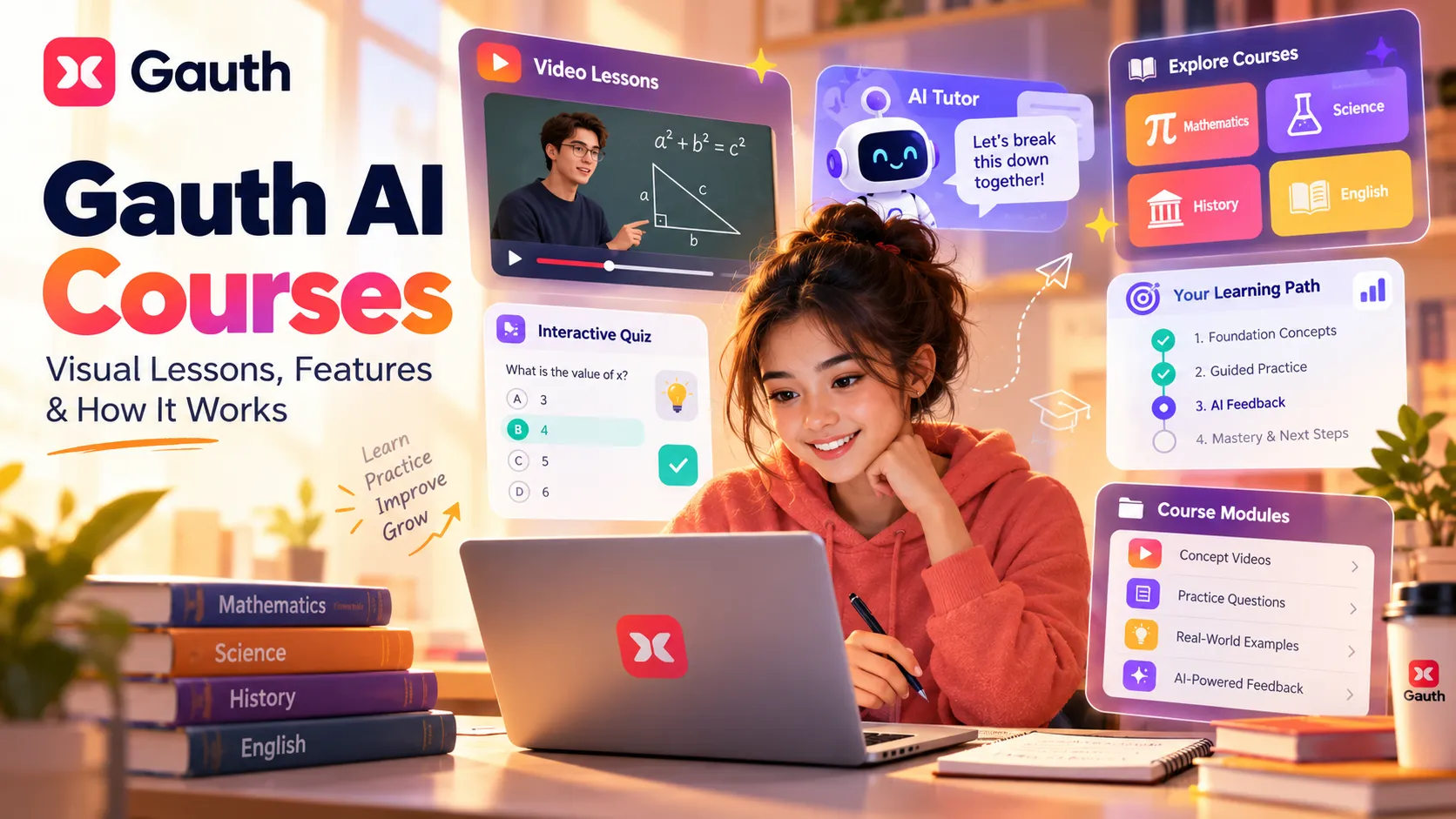
Gauth AI Courses are Gauth’s move beyond one-question homework help into structured learning. The current course experience includes cinematic history lessons, structured math and science curricula, interactive visual material, quizzes and AI tutoring.
Gauth’s subscription page calls the feature AI Courses, while some current course pages use the Gauth Academy label. Both are part of Gauth’s broader course-learning experience.
Quick Answer
Gauth AI Courses provide structured, visual learning instead of only solving individual homework questions. Current Gauth course content includes AI-built history video lessons, large math curricula and interactive science topics. Gauth has also introduced personalized micro-courses that can be generated around a learner’s topic, level and specific area of interest.
What Are Gauth AI Courses?
Gauth originally became popular for solving individual questions. AI Courses shift the product toward teaching a topic over a sequence of lessons.
The official Gauth course page currently describes its history experience as “AI-built interactive lessons that unfold around your curiosity.”
The course system is not limited to one format. Current Gauth pages show several learning styles:
- Cinematic AI video lessons for history
- Structured math curricula with lessons and topics
- Interactive science content
- Visual explanations and models
- Quizzes and knowledge checks
- AI tutor support
- Personalized course generation for specific learning needs
What Is Different About Gauth’s AI Course Approach?
A normal online course is usually produced once for a large audience. Everyone follows roughly the same content.
Gauth is experimenting with a second model: generate a smaller course around what one learner actually wants to understand.
That makes the system potentially useful for a student who understands most of a topic but is stuck on one narrow concept and does not need an entire semester-long course.
Two Types of Gauth AI Courses
Current coverage of the feature points to two broad course paths.
1. Gauth-Produced Courses
These are existing courses and lesson libraries created and published inside Gauth.
Examples currently visible on Gauth include history courses, structured geometry lessons and science topics in physics, biology, chemistry and medicine.
2. Personalized AI-Generated Courses
Gauth has also introduced a more personalized route where the learner can define the topic, current level and exact area they want to understand.
The AI can then build a smaller course around that request rather than forcing the student into a generic sequence designed for everyone.
Gauth’s Cinematic AI Video Courses
One of the freshest parts of the product is the use of AI-generated cinematic video for learning.
The current history course page identifies Seedance 2.5 and includes lessons such as:
- The Pacific War
- World War I
- The Meiji Restoration
- Global Silver Trade
- The Outbreak of World War II
- The Industrial Revolution
- The Age of Exploration
The idea is to turn a historical concept into a visual story rather than presenting only text and static images.
What Is Seedance’s Role?
Seedance is ByteDance’s AI video-generation technology. Gauth has used Seedance 2.5 for its cinematic history course experience.
A Forbes report on Gauth AI Course describes Gauth combining visual lessons with narration, video, quizzes and an AI tutor, while also allowing students to request personalized micro-courses.
Not every Gauth course page should be assumed to use the same video-generation pipeline. The Seedance branding is explicit on the current history course experience, while other math and science course pages use different structured and interactive formats.
What Subjects Are Available?
Gauth’s current course pages show that the platform has expanded well beyond the initial history-video launch.
| Course area | Examples currently visible |
|---|---|
| History | World wars, Industrial Revolution, Meiji Restoration, global trade, exploration |
| Math | Geometry and structured curriculum topics |
| Physics | Everyday systems such as lenses, sound and motion |
| Biology | Cells, membranes, photosynthesis and related processes |
| Chemistry | Atomic structure, periodic trends and molecular concepts |
| Medicine / Nursing | Heart, circulation, breathing and anatomy concepts |
How Large Are the Structured Courses?
Some Gauth course pages are substantial rather than short AI demos.
For example, the current Geometry course lists 61 lessons and 473 topics across 21 units. The curriculum includes points and lines, proofs, coordinate geometry, triangles, similarity, trigonometry, area, volume, circles and transformations.
This shows that Gauth’s course strategy includes both short visual experiences and larger structured subject curricula.
How Do Personalized Gauth Courses Work?
Published information about Gauth’s personalized course system describes a learner choosing three important inputs:
- The topic they want to learn
- Their current level
- The exact area or gap they want explained
The system can then create a visual micro-course around those choices.
This is different from normal personalization that only changes the next recommended lesson. The learner helps define what course should be created in the first place.
What Can a Gauth AI Course Include?
Depending on the course format, current descriptions and course pages show elements such as:
- AI narration
- Visual or cinematic video
- Mind maps and frameworks
- Interactive models
- Quizzes
- Structured lesson units
- AI tutor questions and follow-ups
This makes AI Courses more interactive than simply reading a generated article about a topic.
Can You Ask Questions During a Course?
Gauth’s newer course approach includes AI tutoring alongside course material.
Published descriptions of the personalized course feature say students can pause and ask questions when they need clarification rather than waiting until the end of a lesson.
That is one of the main ways AI-generated courses differ from a traditional prerecorded video library.
Are Gauth AI Courses Free?
Gauth’s current subscription comparison says the Free plan includes standard access to AI Courses, while Gauth Plus includes premium access to AI Courses.
Gauth does not publicly define every standard-vs-premium course restriction in a simple feature table, so it would be unsafe to assume that every course or personalized generation is fully available on Free.
For current subscription prices and other limits, see our Gauth AI pricing guide.
Gauth AI Courses vs Gauth Atlas
| AI Courses | Gauth Atlas |
|---|---|
| Structured learning sequence | Open-ended visual exploration |
| Lessons, units and quizzes | Clickable topic relationships |
| Can include videos and narration | Built around visual discovery |
| Standard/Premium course access | Uses monthly Atlas credits |
| Better for following a curriculum | Better for following curiosity |
For a deeper explanation of the exploratory feature, see our Gauth Atlas guide.
Gauth AI Courses vs Normal Gauth AI
The difference is mostly about scope.
Normal Gauth AI: “Help me solve this question.”
AI Course: “Help me learn this topic.”
The homework solver is optimized for immediate problems. Courses are designed for deeper, repeated learning over a broader concept.
Can Students Create Their Own Gauth Courses?
Gauth has introduced a personalized generation path where the learner requests a course around their needs.
The finished course can also be useful beyond the original learner if a classmate has a similar gap, although exact sharing controls and availability can change as the feature develops.
Are AI-Generated Courses Reliable?
AI-generated educational material should still be checked.
Cinematic presentation can make an explanation memorable, but polished visuals do not guarantee every fact, date, equation or interpretation is correct.
For school assignments, use course materials, textbooks and teacher guidance as the final authority when a generated lesson conflicts with required material.
Who Are Gauth AI Courses Best For?
The feature may be useful for students who:
- Learn better from visual explanations.
- Want a structured path instead of isolated answers.
- Need to fill one narrow knowledge gap.
- Prefer video and interactive material over long text.
- Want to ask an AI tutor questions during a lesson.
- Already use Gauth for homework and want a deeper learning mode.
Who May Prefer Another Learning Format?
If you only need one answer quickly, normal Gauth AI is faster.
If you prefer exploring connections without following a predefined sequence, Atlas may be a better fit.
And if your school requires a specific textbook, syllabus or instructor method, an AI-generated course should supplement—not replace—that material.
How AI Courses Fit Into Gauth
AI Courses show how Gauth is moving from “homework helper” toward a broader study platform.
The current ecosystem now includes:
- Question solving with Gauth AI
- Interactive AI tutoring
- Human tutor support
- Visual exploration through Atlas
- Structured and personalized AI Courses
- A large question bank
Our What Is Gauth AI? guide explains the full product ecosystem.
Frequently Asked Questions
What are Gauth AI Courses?
Gauth AI Courses are structured learning experiences that can include visual lessons, video, narration, quizzes, interactive material and AI tutoring rather than only one-question homework solutions.
Are Gauth AI Courses free?
The current Gauth Free plan includes standard access to AI Courses, while Gauth Plus provides premium access. Gauth does not publicly list every restriction between those access levels in one detailed table.
Does Gauth use Seedance for AI Courses?
Gauth’s current cinematic history course page explicitly identifies Seedance 2.5. Other math and science course formats should not automatically be assumed to use the same generation pipeline.
Can Gauth create a personalized course?
Yes. Gauth has introduced personalized micro-courses where learners can specify a topic, their current level and the particular area they want to understand.
What is the difference between Gauth AI Courses and Atlas?
AI Courses follow structured lessons or a generated learning path. Atlas is an open-ended visual exploration system where users click into related concepts and follow their curiosity.
What subjects do Gauth AI Courses cover?
Current Gauth course pages include history, geometry, physics, biology, chemistry and medicine/nursing content, with additional structured and personalized course experiences continuing to expand.
Final Thoughts
Gauth AI Courses are one of the clearest signs that Gauth wants to become more than a homework-answer app. The product now combines cinematic AI lessons, large structured curricula and personalized course generation around a student’s own learning gap.
The most interesting part is not simply AI-generated video. It is the ability to combine a learning path with quizzes and an AI tutor, then potentially build a course for a very specific need that would be too narrow for a traditional course producer to create.




2 Comments