Gauth Atlas Explained: Features, Credits & How It Works
Gauth Atlas is a visual learning feature inside Gauth that turns a topic into an explorable map of images, concepts and related ideas. Instead of reading one linear answer, you can click into a detail, move into related concepts and continue exploring the subject visually.
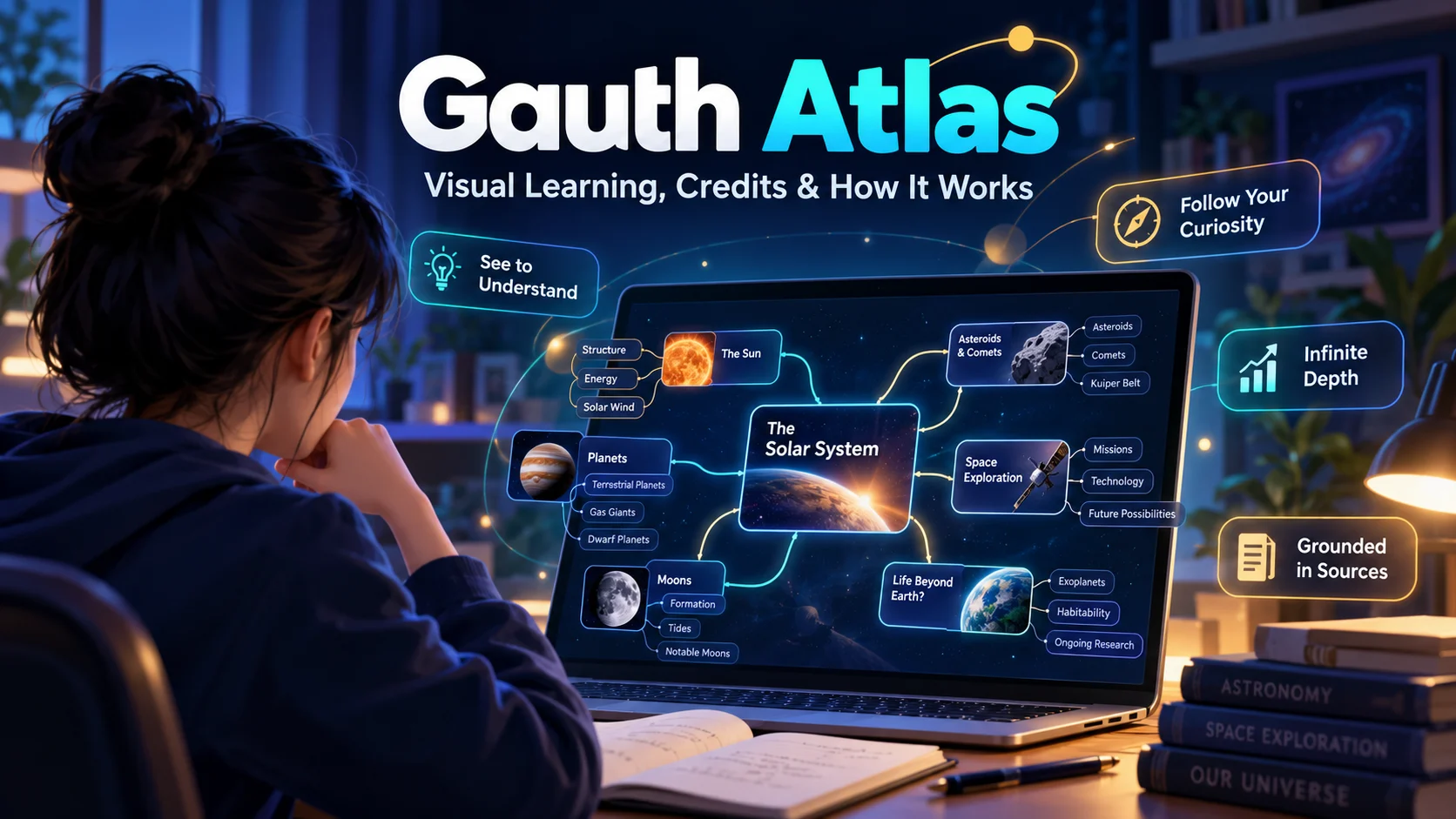
Gauth positions Atlas around four ideas: making complex concepts visible, following curiosity through clickable exploration, zooming into deeper levels of a topic and grounding visual material in sources.
Quick Answer
Gauth Atlas is an interactive visual learning tool that lets you enter a topic and explore it through connected visual explanations. Gauth says every image can be traced back to a real source. The free Gauth plan currently includes 10 Atlas credits per month, while Gauth Plus includes 100 credits per month.
What Is Gauth Atlas?
Atlas is part of the wider Gauth study platform, but it is different from the normal Gauth AI homework solver.
With normal Gauth AI, the starting point is usually a question: type or upload the problem, then receive a worked answer.
With Atlas, the starting point is a topic you want to explore. Gauth describes Atlas as turning “any subject into a visual adventure for curious minds.”
The official Gauth homepage currently presents Atlas around four core ideas:
- See to Understand: make complex ideas visual.
- Follow Your Curiosity: click into related ideas and continue exploring.
- Infinite Depth: zoom into details instead of stopping at one explanation.
- Grounded in Sources: Gauth says every image can be traced to a real source.
How Does Gauth Atlas Work?
The current Atlas page is intentionally simple. You sign in, enter a new topic and start exploring.
A typical workflow is:
- Open Gauth Atlas.
- Enter a topic you want to learn about.
- Atlas creates a visual exploration around that topic.
- Click a concept or visual element that interests you.
- Move deeper into related details.
- Continue following the topic rather than returning to a normal search-results list.
The experience is designed to make exploration less linear than a textbook page or a normal AI chat response.
What Does “Visual Adventure” Mean?
Gauth uses “visual adventure” to describe the way Atlas presents a subject as something you can navigate rather than simply read.
That makes Atlas potentially useful for topics where relationships, structures, timelines, systems or visual context matter.
For example, a student exploring a science topic may want to move from an overview into one component, then into the process involving that component, rather than asking separate questions manually.
Gauth Atlas Credits Explained
Atlas uses a credit system.
The current official Gauth Plus comparison lists:
| Plan | Atlas credits |
|---|---|
| Gauth Free | 10 credits per month |
| Gauth Plus | 100 credits per month |
That is a 10× larger monthly Atlas allowance on Plus.
How Much Does One Gauth Atlas Credit Do?
This is one area where Gauth’s public documentation is currently incomplete.
Gauth clearly publishes the monthly allowance—10 credits on Free and 100 on Plus—but its current public documentation does not define a fixed rule such as “one topic costs one credit” or “one click costs one credit.”
Because of that, it would be misleading to calculate an exact number of Atlas explorations from the monthly allowance without seeing the current in-product credit behavior.
If Gauth adds a public credit-consumption explanation later, this is one of the sections that should be updated.
Is Gauth Atlas Free?
Atlas is available on the free plan, but usage is limited by credits.
Free accounts currently receive 10 Atlas credits per month. This makes Atlas testable without buying Gauth Plus.
Plus increases the allowance to 100 credits per month and also includes broader premium access across the Gauth ecosystem.
For the complete Free vs Plus comparison, see our Gauth AI pricing guide.
Is Gauth Atlas a Separate App?
No. Gauth Atlas is a feature of Gauth, not the unrelated “Atlas: AI Study Companion” app from another developer.
This distinction matters because searching “Atlas AI study” can surface products that are not connected to Gauth.
The official Gauth Atlas experience is found on the Gauth/Gauthmath web ecosystem and is linked from the main Gauth product.
Gauth Atlas vs Normal Gauth AI
| Gauth AI | Gauth Atlas |
|---|---|
| Starts with a homework question | Starts with a topic to explore |
| Returns a step-by-step solution | Builds a visual exploration |
| Best for getting unstuck on a problem | Best for understanding and exploring a subject |
| Text/image question workflow | Interactive visual navigation |
| AI query/answer limits apply | Atlas credit allowance applies |
The two features can complement each other. Atlas can help build a visual understanding of a concept, while Gauth AI can then help with a specific problem involving that concept.
Gauth Atlas vs AI Courses
Atlas and AI Courses are both learning-focused Gauth features, but their structure is different.
Atlas is exploratory. You choose where to go next.
AI Courses are structured. They organize material into lessons, topics or guided learning sequences.
If you want to follow curiosity through a visual topic map, Atlas is the more relevant feature. If you want a planned sequence of lessons, AI Courses are the better fit.
See our Gauth AI Courses guide for the course side of the platform.
What Subjects Can You Explore With Gauth Atlas?
Gauth markets Atlas as working with “any subject.” The broader Gauth platform currently covers math, calculus, chemistry, biology, business, social science and additional topics.
Because Atlas is topic-driven rather than tied to one fixed math solver, its concept is broader than a STEM-only visualizer.
However, the depth and usefulness of a generated exploration can vary by topic. Gauth does not publish a complete Atlas subject-coverage list or a universal quality guarantee for every topic.
What Does “Grounded in Sources” Mean?
Gauth says every Atlas image traces back to a real source.
That is a useful design choice because visual AI systems can otherwise present generated-looking material without clear provenance.
Still, “grounded in sources” should not be interpreted as a guarantee that every generated explanation is academically perfect. Students should open or inspect sources when a fact matters for an assignment.
Can Gauth Atlas Replace a Textbook?
It is better treated as an exploration and explanation layer, not a replacement for course materials.
A textbook, teacher or course usually provides a required sequence, definitions, notation and assessment expectations. Atlas is more useful for making a difficult idea easier to visualize or for discovering connections you want to investigate further.
Who Is Gauth Atlas Best For?
Atlas may be particularly useful for students who:
- Learn better from visuals than dense text.
- Like exploring related ideas instead of following one rigid path.
- Need a concept made more concrete before solving problems.
- Want a discovery tool alongside normal homework help.
- Already use Gauth and want more than scan-and-solve answers.
Who May Not Need Atlas?
If you mainly open Gauth to solve one homework problem quickly, normal Gauth AI may be more direct.
Students who prefer linear lessons may also get more value from AI Courses rather than a curiosity-driven visual map.
Is Gauth Plus Worth It for Atlas Alone?
The answer depends on how quickly you use the free 10-credit allowance.
Plus gives 100 monthly credits, but Atlas is only one of several paid benefits. The membership also expands answers, Gauth AI Pro, AI queries, AI Courses and the question bank.
Before subscribing only for Atlas, use the free credits first and see whether the feature becomes part of your normal study routine.
How Atlas Fits Into the Gauth Ecosystem
Gauth now has several different learning modes:
| Gauth feature | Best suited to |
|---|---|
| Gauth AI | Specific questions and worked solutions |
| AI Live Tutor | Conversational explanation |
| Human tutors | Personalized expert help |
| Gauth Atlas | Visual topic exploration |
| AI Courses | Structured lesson sequences |
| Question bank | Practice and existing solutions |
Our What Is Gauth AI? guide explains how all of those products fit together.
Frequently Asked Questions
What is Gauth Atlas?
Gauth Atlas is an interactive visual learning feature that turns a topic into an explorable visual experience with connected ideas and source-linked imagery.
Is Gauth Atlas free?
Yes, but free usage is limited. The current Gauth Free plan includes 10 Atlas credits per month, while Gauth Plus includes 100 credits per month.
How much is one Gauth Atlas credit worth?
Gauth publicly lists the monthly Atlas credit allowances but does not currently publish a fixed rule explaining exactly how many credits each topic, generation or exploration action consumes.
Is Gauth Atlas a separate app?
No. Gauth Atlas is part of the Gauth study platform. It should not be confused with unrelated study apps that also use the Atlas name.
What is the difference between Gauth Atlas and Gauth AI?
Gauth AI is mainly for answering specific study questions with step-by-step solutions. Atlas is designed for visual exploration of a broader topic and its related concepts.
Does Gauth Atlas show sources?
Gauth says Atlas is grounded in sources and that every image can be traced back to a real source. Students should still inspect sources when accuracy matters for an assignment.
Final Thoughts
Gauth Atlas is one of the more distinctive additions to Gauth because it changes the product from an answer tool into an exploration tool. Instead of asking only “what is the solution?”, Atlas encourages students to follow a concept visually and decide what to explore next.
The main limitation today is documentation around credit consumption. Gauth clearly publishes 10 monthly credits for Free and 100 for Plus, but it does not publicly explain a fixed per-action credit formula. The best approach is to test Atlas with the free allowance before deciding whether Plus is worthwhile for your usage.