Z.ai API Pricing 2026: GLM Models, Token Costs & Free Models
Z.ai uses pay-as-you-go pricing for its public GLM API, with different rates for normal input tokens, cached input tokens and output tokens. The public API is separate from the GLM Coding Plan, which uses subscription credits inside supported coding tools.
Z.ai changes model pricing and promotions frequently, so the figures below use the current official list prices rather than older launch discounts still shown on some third-party pages.
Quick Answer
Z.ai’s current flagship GLM-5.3 API costs $1.40 per 1 million input tokens, $0.26 per 1 million cached-input tokens and $4.40 per 1 million output tokens. GLM-5.3-Flash is much cheaper at $0.15 input, $0.03 cached input and $0.50 output per 1 million tokens. Z.ai also lists several API models with free input and output pricing.
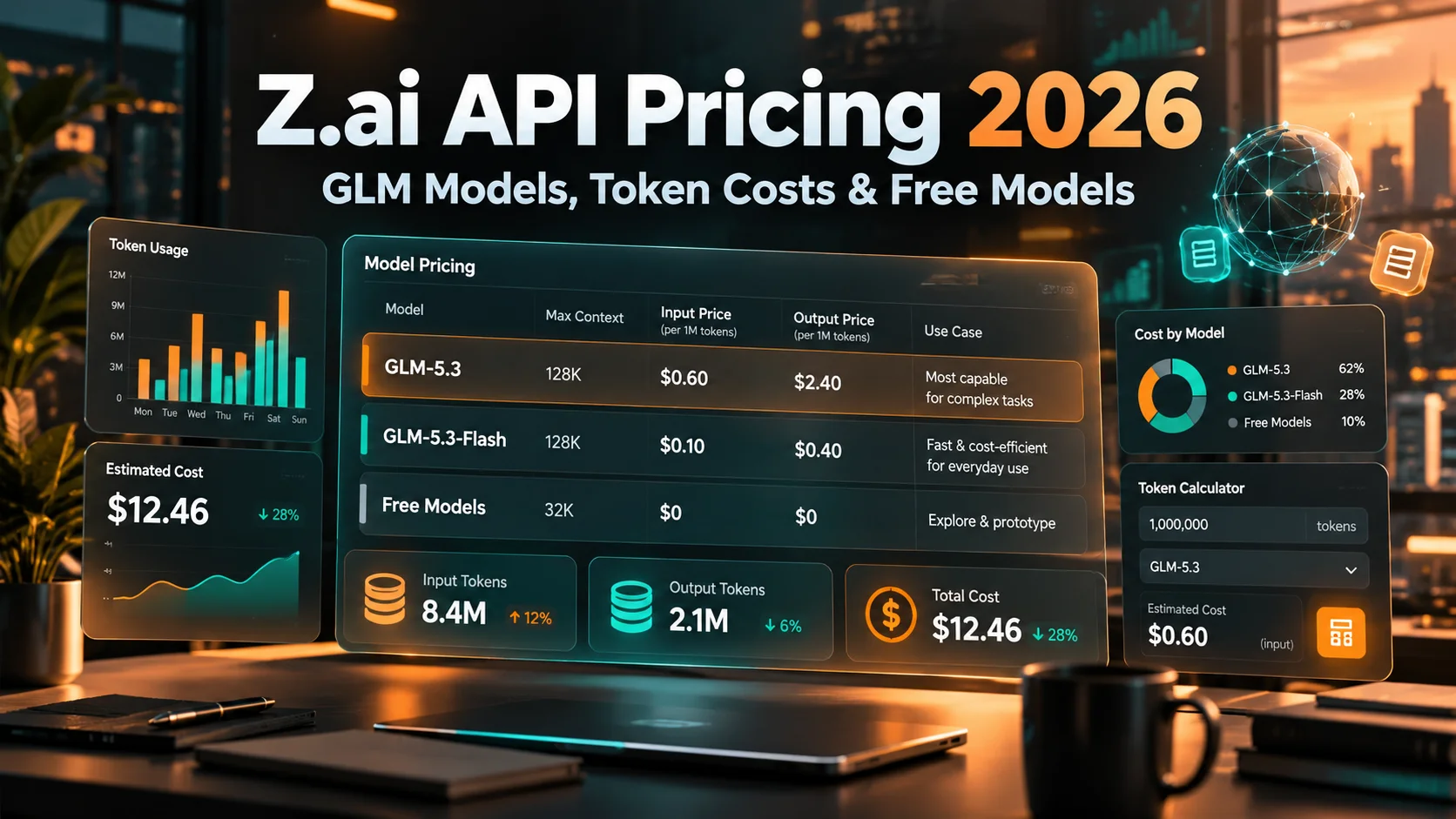
Z.ai API Pricing at a Glance
The official Z.ai pricing page lists all prices in U.S. dollars. The latest GLM models currently have the following rates.
| Model | Input / 1M | Cached input / 1M | Output / 1M |
|---|---|---|---|
| GLM-5.3 | $1.40 | $0.26 | $4.40 |
| GLM-5.3-Flash | $0.15 | $0.03 | $0.50 |
| GLM-5.3-FlashX | $0.37 | $0.075 | $1.25 |
| GLM-5.2 | $1.40 | $0.26 | $4.40 |
Cached-input storage is currently marked as limited-time free for these models. That is different from cached-input processing, which still has its own per-token rate.
GLM-5.3 API Pricing
GLM-5.3 is Z.ai’s current flagship text model for coding, reasoning and agentic workloads. Its public API pricing is:
- Input: $1.40 per 1 million tokens
- Cached input: $0.26 per 1 million tokens
- Output: $4.40 per 1 million tokens
- Cached-input storage: currently listed as limited-time free
GLM-5.3 and GLM-5.2 currently have the same published API rates, so cost alone is not a reason to choose the older model.
GLM-5.3-Flash API Pricing
GLM-5.3-Flash is substantially cheaper:
- Input: $0.15 per 1 million tokens
- Cached input: $0.03 per 1 million tokens
- Output: $0.50 per 1 million tokens
This is the current standard list price. Some pages published around the model’s launch still show lower temporary promotional rates such as $0.075 input and $0.25 output. Those figures should not be treated as the current permanent API price.
GLM-5.3-Flash also supports multimodal inputs and a 1 million-token context window. Our GLM-5.3-Flash guide covers the model’s features, FlashX and Coding Plan availability in more detail.
What Is GLM-5.3-FlashX Pricing?
GLM-5.3-FlashX is the faster-serving Flash variant. Its current API rates are:
- Input: $0.37 per 1 million tokens
- Cached input: $0.075 per 1 million tokens
- Output: $1.25 per 1 million tokens
FlashX costs more than standard Flash but remains much cheaper than GLM-5.3 at current list prices. It is a separate API option and should not be confused with GLM-5.3-Flash usage included in the Coding Plan.
Current Z.ai Text Model Pricing
| Text model | Input / 1M | Cached input / 1M | Output / 1M |
|---|---|---|---|
| GLM-5.1 | $1.40 | $0.26 | $4.40 |
| GLM-5 | $1.00 | $0.20 | $3.20 |
| GLM-4.7 | $0.60 | $0.11 | $2.20 |
| GLM-4.7-FlashX | $0.07 | $0.01 | $0.40 |
| GLM-4.6 | $0.60 | $0.11 | $2.20 |
| GLM-4.5 | $0.60 | $0.11 | $2.20 |
| GLM-4.5-X | $2.20 | $0.45 | $8.90 |
| GLM-4.5-Air | $0.20 | $0.03 | $1.10 |
| GLM-4.5-AirX | $1.10 | $0.22 | $4.50 |
| GLM-4-32B-0414-128K | $0.10 | — | $0.10 |
| GLM-4.7-Flash | Free | Free | Free |
| GLM-4.5-Flash | Free | Free | Free |
Which Z.ai API Models Are Free?
The current official pricing table lists several models with free input and output pricing:
- GLM-4.7-Flash
- GLM-4.5-Flash
- GLM-4.6V-Flash
“Free” on the pricing table means the listed token prices are zero. It does not necessarily mean unlimited throughput or guaranteed capacity. Account-level rate limits can still affect how quickly requests can be made.
Z.ai Vision Model Pricing
| Vision model | Input / 1M | Cached input / 1M | Output / 1M |
|---|---|---|---|
| GLM-4.6V | $0.30 | $0.05 | $0.90 |
| GLM-OCR | $0.03 | — | $0.03 |
| GLM-4.6V-FlashX | $0.04 | $0.004 | $0.40 |
| GLM-4.5V | $0.60 | $0.11 | $1.80 |
| GLM-4.6V-Flash | Free | Free | Free |
Other Z.ai API Costs
Z.ai also publishes prices for tools and generation models that are not billed like normal text tokens.
| Product | Current price |
|---|---|
| Web Search | $0.01 per use |
| GLM-Image | $0.015 per image |
| CogView-4 | $0.01 per image |
| CogVideoX-3 | $0.20 per video |
| GLM-ASR-2512 | $0.03 per million tokens, approximately $0.0024/minute |
| GLM Slide/Poster Agent (beta) | $0.70 per million tokens |
| General-Purpose Translation | $3 per million tokens |
How Z.ai API Billing Works
For token-priced models, the basic cost depends on how many normal input, cached-input and output tokens your request uses.
A simplified calculation is:
Total cost =
(input tokens / 1,000,000 × input rate)
+ (cached input tokens / 1,000,000 × cached-input rate)
+ (output tokens / 1,000,000 × output rate)
Output is normally more expensive than input, so a workflow that generates very long responses can cost significantly more than one that mainly reads context.
Example: 100K Input + 20K Output
For a request with 100,000 standard input tokens and 20,000 output tokens, with no cached input:
| Model | Approximate cost |
|---|---|
| GLM-5.3 | $0.228 |
| GLM-5.3-FlashX | $0.062 |
| GLM-5.3-Flash | $0.025 |
| GLM-4.7 | $0.104 |
This example shows why Flash can be attractive for high-volume applications, although model capability and multimodal requirements should matter more than token price alone.
How Cached Input Changes the Cost
Cached input is priced much lower than normal input. This can matter for coding agents, large system prompts, document workflows and applications that repeatedly send the same prefix or context.
For example, if a GLM-5.3 request has 200,000 new input tokens, 800,000 cached-input tokens and 50,000 output tokens, the approximate model charge at current list rates is $0.708. The same token mix on GLM-5.3-Flash is about $0.079.
Actual billing depends on how much content qualifies for cache reuse, so do not assume your full context will always be billed at the cached-input rate.
Z.ai API Pricing vs GLM Coding Plan
The public API and GLM Coding Plan are two different billing systems.
| Public Z.ai API | GLM Coding Plan |
|---|---|
| Pay as you go | Subscription |
| Usually billed by tokens or tool usage | Uses plan credits |
| Designed for apps, integrations and direct API calls | Designed for officially supported coding tools |
| Normal API endpoint | Dedicated coding endpoints |
| Usage depends on account billing balance | 5-hour and weekly plan limits |
Z.ai explicitly states that Coding Plan quota is limited to officially supported tools and does not act as a general-purpose API balance. If you are comparing the subscriptions rather than token prices, read our Z.ai Coding Plan pricing guide.
Can You Use the Coding Plan API Key for Normal API Calls?
You should not treat Coding Plan quota as ordinary API credit. Z.ai says calls made through supported Coding Plan tools consume only the plan quota, while API calls outside the plan are not available through that subscription quota.
For Claude Code specifically, Z.ai provides a dedicated Anthropic-compatible endpoint. This is separate from the normal public API route and is designed for supported Coding Plan use through Claude Code.
How to Start Using the Z.ai API
Z.ai’s official API Quick Start outlines the basic process:
- Create or sign in to a Z.ai account.
- Top up your billing balance if the model requires paid usage.
- Create an API key.
- Select the model you want to use.
- Call the API through HTTP, Z.ai’s SDKs or a compatible OpenAI SDK.
The standard chat-completions endpoint documented for direct API usage is:
https://api.z.ai/api/paas/v4/chat/completionsZ.ai also documents an OpenAI-compatible base URL, making migration easier for applications already built around OpenAI-style SDKs.
Which Z.ai Model Is Cheapest?
If the only requirement is zero listed token cost, the free Flash models are the cheapest. Among the current paid text models, GLM-4.7-FlashX has a very low published input price, while GLM-5.3-Flash is the lower-cost option in the newest GLM-5.3 family.
The cheapest model is not automatically the best choice. Context length, multimodal support, coding performance, latency and output quality can change the real cost of completing a task.
Why Z.ai API Prices Can Look Different Across Websites
Three things commonly cause conflicting numbers:
- Temporary promotions: launch discounts may expire while older articles remain online.
- Third-party hosts: open-weight GLM models can be served by other providers at different prices.
- Different billing products: API token rates and Coding Plan credits are not directly interchangeable.
For budgeting against Z.ai itself, use the current official Z.ai pricing table rather than a third-party host’s rate or an expired promotional price.
Frequently Asked Questions
1. What is the current price of GLM-5.3 API?
GLM-5.3 currently costs $1.40 per 1 million input tokens, $0.26 per 1 million cached-input tokens, and $4.40 per 1 million output tokens. Cached-input storage is currently listed as limited-time free.
2. Is GLM-5.3-Flash free?
No. GLM-5.3-Flash is a paid API model. Its current list price is $0.15 per 1 million input tokens, $0.03 per 1 million cached-input tokens, and $0.50 per 1 million output tokens. Z.ai does, however, offer separate Flash models with zero listed token prices.
3. Which Z.ai models are available for free?
Z.ai’s current pricing table lists GLM-4.7-Flash, GLM-4.5-Flash, and GLM-4.6V-Flash with free input and output token pricing. Free pricing does not necessarily mean unlimited usage, since account-level limits and capacity restrictions can still apply.
4. Is the Z.ai Coding Plan the same as API billing?
No. The Coding Plan and public API use different billing systems. The public API generally charges according to token or tool usage, while the Coding Plan uses subscription-based quotas and is intended for supported coding tools. Coding Plan quota should not be treated as general-purpose API credit.
Final Thoughts
Z.ai’s API pricing spans everything from free Flash models to the flagship GLM-5.3. The biggest current pricing difference inside the newest model family is between GLM-5.3 and GLM-5.3-Flash: Flash costs a fraction of the flagship’s token rates while also adding multimodal input.
For applications and direct integrations, calculate costs using the public API rates. For AI coding tools such as Claude Code, compare those costs with the separate Coding Plan rather than assuming the subscription and API use the same billing system.
For an overview of the broader platform, see our What Is Z.ai? guide.