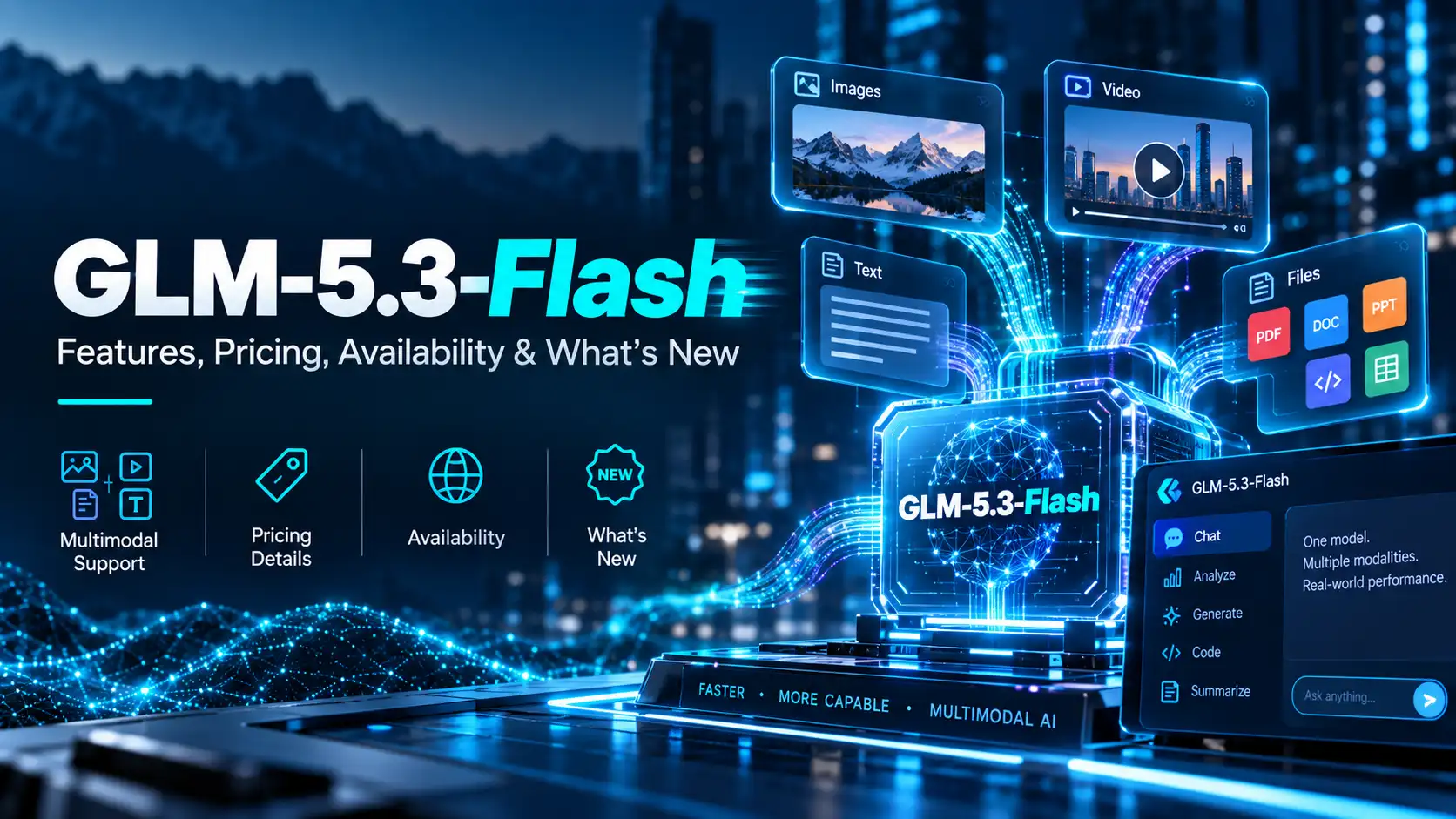
GLM-5.3-Flash: Features, Pricing, Availability & What’s New
GLM-5.3-Flash is a multimodal AI model from Z.ai designed to combine lower-cost inference with strong coding, visual understanding and agentic capabilities. It was released on August 26, 2026, and Z.ai describes it as the first native multimodal model in the GLM-5 series.
The model is particularly interesting because it accepts text, images, video and files, supports a 1 million-token context window, and is priced far below GLM-5.3 for API usage.
Quick Answer
GLM-5.3-Flash is Z.ai’s lower-cost multimodal model for coding, visual tasks, computer use and agentic workflows. It supports text, images, video and files as input, offers a 1 million-token context window, and is available through Z.ai’s API and GLM Coding Plan.
What Is GLM-5.3-Flash?
According to the official GLM-5.3-Flash documentation, the model is the first native multimodal model in the GLM-5 series. It is designed for tasks involving text, images, video, files, coding and computer-use workflows.
Z.ai positions the model as a more economical option than GLM-5.3 while still targeting demanding coding and agentic workloads.
GLM-5.3-Flash Specs
| Specification | GLM-5.3-Flash |
|---|---|
| Release date | August 26, 2026 |
| Input types | Text, image, video and file |
| Output | Text |
| Context window | 1 million tokens |
| Maximum output | 128,000 tokens |
| Total parameters | 320B |
| Activated parameters | 18B |
| Architecture | Mixture of Experts |
| Thinking | Always enabled |
What Makes GLM-5.3-Flash Different?
The biggest difference is native multimodal support. GLM-5.3 is primarily a text model, while GLM-5.3-Flash can work with visual and file-based input directly.
Z.ai also highlights a hybrid sparse and linear attention design intended to reduce attention computation and KV-cache requirements compared with GLM-5.3.
GLM-5.3-Flash vs GLM-5.3
| Feature | GLM-5.3 | GLM-5.3-Flash |
|---|---|---|
| Main input | Text | Text, image, video, file |
| Context window | 1M | 1M |
| Max output | 128K | 128K |
| Reasoning | Always on | Always on |
| API input price | $1.40 / M | $0.15 / M |
| API output price | $4.40 / M | $0.50 / M |
| Multimodal input | No | Yes |
For users focused on the wider Z.ai ecosystem, our What Is Z.ai? guide explains how the model fits alongside ZCode, the API platform and the Coding Plan.
GLM-5.3-Flash API Pricing
Current official Z.ai API pricing lists GLM-5.3-Flash at $0.15 per million input tokens, $0.03 per million cached-input tokens and $0.50 per million output tokens.
| Model | Input / 1M | Cached input / 1M | Output / 1M |
|---|---|---|---|
| GLM-5.3-Flash | $0.15 | $0.03 | $0.50 |
| GLM-5.3-FlashX | $0.37 | $0.075 | $1.25 |
| GLM-5.3 | $1.40 | $0.26 | $4.40 |
What Is GLM-5.3-FlashX?
GLM-5.3-FlashX is a higher-speed variant of Flash. Z.ai currently lists inference speeds of up to 200 tokens per second for FlashX.
FlashX costs more than standard Flash but remains cheaper than GLM-5.3 on the current API price table. It is also not currently included in the GLM Coding Plan.
Is GLM-5.3-Flash Multimodal?
Yes. This is one of the model’s defining features. It accepts video, image, text and file input and returns text output.
Z.ai specifically highlights visual programming, computer use, GUI automation, video understanding, Blender-related tasks, CAD reproduction and office-document generation as areas the model can support.
Computer Use and Visual Coding
GLM-5.3-Flash is designed to work with rendered interfaces and visual feedback, which makes it relevant to agentic tools that need to observe a screen, interact with an interface and verify results.
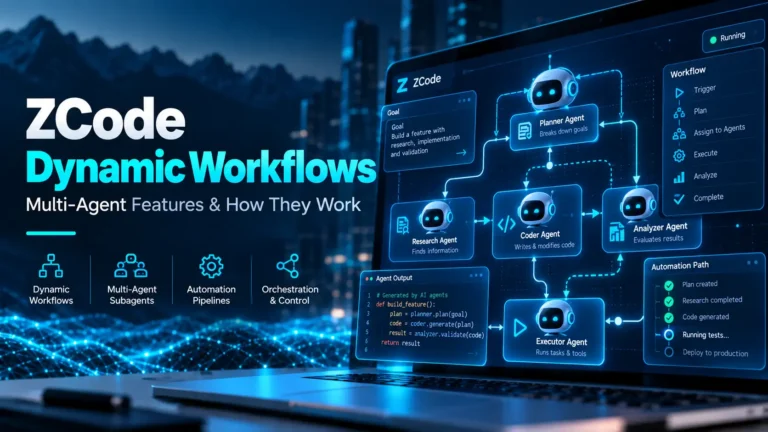
That capability is also relevant to ZCode, where the model can be used alongside visual and browser-based development workflows. For the development environment itself, see our What Is ZCode? guide. ZCode’s newer multi-agent orchestration is covered in our ZCode Dynamic Workflows explainer.
Thinking Mode Cannot Be Disabled
GLM-5.3-Flash keeps reasoning enabled. Current documentation does not support turning thinking off completely.
Z.ai’s documented settings recommend using reasoning controls rather than trying to disable the feature.
Is GLM-5.3-Flash Available on the Coding Plan?
Yes. Z.ai says GLM-5.3-Flash is fully available on the GLM Coding Plan and provides three times the available quota compared with GLM-5.3 under the current plan mechanics. Claude Code is one of the supported tools, and Z.ai documents both GLM-5.3 and GLM-5.3-Flash model mappings for it.
That difference reflects the lower credit multipliers used by Flash. Our Z.ai Coding Plan comparison explains the current Lite, Pro and Max limits, credit multipliers and off-peak rules.
Current GLM-5.3-Flash Campaign
As of October 2, 2026, Z.ai’s official campaign page still lists the GLM-5.3-Flash usage campaign as active through October 7. Every day from 23:00 to 09:00 Singapore Time (UTC+8), paid Coding Plan users get zero-quota Flash usage through ZCode or AutoClaw, while other supported agents receive double the standard Flash quota.
The campaign requires ZCode 3.10 or later and is promotional rather than a permanent product feature. Readers checking this article after October 7 should verify whether the offer has ended or been extended.
What Was “ox-alpha”?
Before the public release, Z.ai says the model was tested anonymously under the name “ox-alpha” on services including OpenCode and OpenRouter.
Z.ai says the anonymous model became the most popular model of the week during that period. That is a vendor-reported launch detail rather than an independent benchmark.
How Does GLM-5.3-Flash Perform?
Z.ai publishes benchmark results showing strong coding and automation performance, including improvements over GLM-5.2 on several tests. The company also says GLM-5.3-Flash approaches Claude Opus 4.8 on some internal or selected benchmark comparisons.
These figures should be read as vendor-reported benchmark results, not as a universal guarantee of real-world performance. Different workloads, tools, context sizes and latency requirements can produce different results.
Is GLM-5.3-Flash Free?
Not as a general pay-as-you-go API model. The current API price table lists paid input and output rates for GLM-5.3-Flash.
Free or zero-quota access can exist through temporary campaigns, and Z.ai also offers other Flash-branded API models with free pricing. Users should not assume that the word “Flash” automatically means free.
Who Is GLM-5.3-Flash For?
GLM-5.3-Flash is most relevant to developers and AI-tool users who want multimodal input, lower token costs, visual coding or agentic computer-use features without paying GLM-5.3’s higher API rates.
It may also make sense for Coding Plan users who want more effective quota for everyday agent workloads. GLM-5.3 may remain more appropriate when the flagship model’s coding and reasoning capabilities are more important than cost.
Frequently Asked Questions
When was GLM-5.3-Flash released?
Z.ai’s official release notes list GLM-5.3-Flash as released on August 26, 2026.
Is GLM-5.3-Flash multimodal?
Yes. It accepts text, images, video and files as input and returns text output.
What is the GLM-5.3-Flash context window?
Current Z.ai documentation lists a 1 million-token context window and up to 128,000 tokens of output.
How much does GLM-5.3-Flash cost?
Current API pricing lists $0.15 per million input tokens, $0.03 per million cached-input tokens and $0.50 per million output tokens.
Is GLM-5.3-Flash available on the Coding Plan?
Yes. Z.ai says GLM-5.3-Flash is fully available on the GLM Coding Plan and provides three times the available quota compared with GLM-5.3 under current plan mechanics.
What is GLM-5.3-FlashX?
GLM-5.3-FlashX is a higher-speed variant with separate API pricing. Z.ai lists inference speeds up to 200 tokens per second, and FlashX is not currently on the GLM Coding Plan.
Bottom Line
GLM-5.3-Flash is one of the more important current models in the Z.ai ecosystem because it combines multimodal input, a large context window and much lower API pricing than GLM-5.3.
Its value is strongest for visual, agentic and cost-sensitive workloads, while the flagship GLM-5.3 remains the more premium option for users prioritizing the main coding and reasoning model.


6 Comments